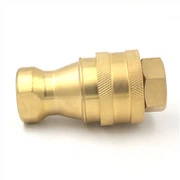
The Structural Composition Of Pure Copper Quick Mould Coupling
Feb 27, 2023
Mold joint (female head) and mold nozzle (male head), which has three structural forms:
1. Pure Copper Quick Mould Coupling and mold water nozzle are closed (mold water nozzle must be the standard length), mold joint and mold water nozzle are open mold water nozzle open, mold joint and mold water nozzle are closed:
A, no connection ----- female head and male head in the respective thimble and spring under the action of the tube channel, male head and female head of the thimble closed respectively, instantly block the fluid flow.
When connecting ----- when the male head is inserted into the female head, the thimble returns to the original position under the action of the spring, the steel ball rolling lock the male head is closely connected, and the female head and the male head of the thimble push each other open, fluid flow, O-ring can completely block the leakage of the fluid.
2. Pure Copper Quick Mould Coupling and mould water nozzle are open
A, not connected ----- When the copper jacket of the female head is pushed to the other end, the steel ball automatically rolls outward, so that the male head is removed; Since neither male nor female heads have valves, fluid flows out.
B. Connection -- When the male head is inserted into the female head, the copper jacket is pushed to the previous position by the force of its spring, causing the steel ball to lock, and the fluid flows, and the O-ring prevents the fluid from flowing out.
3. The mold nozzle is open, and the mold joint is closed
A, not connected ---- when the copper jacket of the female head moves to the other end, the stainless steel bead automatically rolls outward, the male head is bounced open by the reaction force of the valve spring, the valve can automatically close to block the flow of fluid.
B. Connection -- When the male head is inserted into the female head, the copper jacket is pushed to the previous position by the force of its spring, causing the steel ball to lock, and the fluid flows, and the O-ring prevents the fluid from flowing out.