The Working Principle Of Pneumatic Connector
Aug 22, 2023
Pneumatic quick connectors are widely used in the automotive industry, the new energy battery industry, the industrial automation industry, the medical equipment industry, the air-conditioning and refrigeration industries, etc., with their quick-lock design, simple structure, easy-to-understand principle, and convenient operation. The following is a brief introduction to the working principle of the pneumatic quick connector:
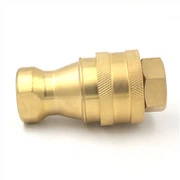
Pure Copper Quick Mould Coupling
Working principle of the pneumatic quick connector
The most important thing about pneumatic joints is to ensure that the parts and seals will not be damaged and will not fail under working conditions. At the same time, it is also convenient for the joints to be easily and quickly inserted and pulled out. Connectors for fluid connection or disconnection.
The working principle of the pneumatic quick connector is that when there is no driving air pressure, the quick connector sealing ring is in a normal state and can be easily inserted or outsourced to the pipe fittings. After inserting to an appropriate depth, fill in the driving air pressure, and the air pressure pushes the metal ring unit in the main sleeve, and then the metal ring unit squeezes the front sealing ring, causing the sealing ring to expand and deform to form a sealing contact with the wall of the sealing pipe fitting to achieve a sealed connection effect.
The sealed pipe is filled with detection medium, and the test is started. Special attention should be paid here to the contact depth between the joint and the sealing pipe fitting. The greater the depth, the larger the contact area and the better the sealing effect. After the sealing test is completed, the air pressure in the sealed pipe should be released first, and then the drive interface should be released for 0.5–1 second. After the pressure is released, the metal ring unit will retreat and release the extrusion on the sealing ring, so that the sealing ring returns to its original shape and breaks away from contact with the pipe wall. After the sealed connection is completed, just pull out the connector gently, and then prepare for the next product test.